

How Custom Cabinetry Can Hide Your Professional Life After 5 PM

When the laptop closes and the last client call ends, your home should feel like home not a second office. At The Burkhart Company, we take pride in designing custom cabinetry that quietly (and beautifully) tucks your professional life out of sight. “How Custom Cabinetry Can Hide Your Professional Life After 5 PM” isn’t just a clever phrase it’s a design approach that turns work zones into furniture-like moments, using materials like walnut and white oak to make every kitchen, pantry, and built-in feel like an intentional part of your home’s architecture.
Why hide the office? The psychology behind putting work away
There’s real value in a clear separation between work and living. A visible monitor, stacks of paper, or an open filing drawer keeps your brain in task mode. Custom millwork lets you create purposeful hiding places from sliding doors and pull-away work surfaces to fully integrated cabinets with soft-close hardware. These solutions give you the mental reset you need at 5 PM, without sacrificing style or functionality. Local Louisville designers and remodelers are increasingly recommending built-in solutions that prioritize both storage and seamless aesthetics.
Walnut and white oak: a tactile alternative to sterile all-white kitchens
The trend away from sterile, all-white kitchens is more than fashion it’s a move toward warmth, texture, and a sense of “lived-in” furniture. Walnut and white oak make an ideal team for this shift:
- Walnut brings rich, deep tones and a refined grain that reads like fine furniture. It reads as intentionally warm and composed perfect for feature panels, islands, or closed doors that need to feel like heirloom pieces. Walnut’s natural character adds depth without fuss.
- White oak offers a lighter, textural counterpoint. Rift or quarter-sawn white oak has a steady, architectural grain and a calm neutrality that plays well with modern and traditional homes alike. Together, walnut and white oak create a layered, architectural look that reads as custom furniture rather than factory cabinetry.
Mixing these species for example, walnut door faces with a white oak perimeter or shelving gives you visual contrast while keeping tone and touch consistent across the room. Designers suggest repeating each wood species in two or three places in the space (island, open shelf, floating mantle) so the combination feels deliberate, not accidental.
Design strategies to conceal your day job
Below are practical ways our custom cabinetry hides work clutter while preserving everyday usability.
1) The “office in a door”
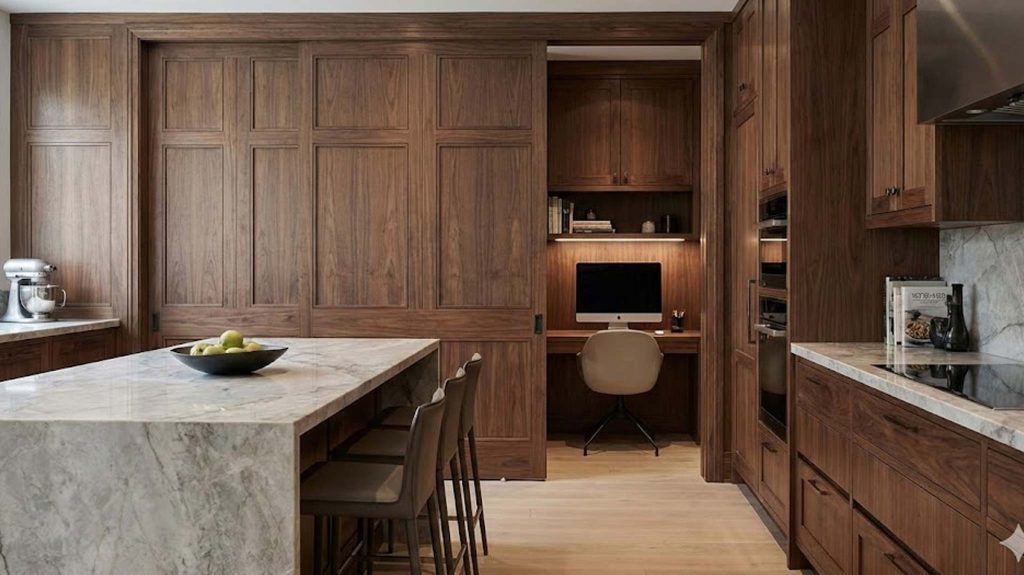
A full-height cabinet with a fold-down or pull-out work surface becomes a self-contained office. When closed, the door reads like an elegant pantry or furniture panel in walnut or white oak; when open, it reveals an ergonomic workspace with cord channels, file drawers, and a charging station. This approach keeps screens and cables out of sight and your kitchen looking like a room, not a workstation.
2) Appliance-panel integration and closed storage
We design cabinetry to accept panels, so appliances vanish into the architecture. That same logic applies to your work tools: assign closed drawers for supplies, hidden cubbies for routers and modems, and a designated spot for your laptop with a soft-close mechanism. The result: everything you need for work is nearby, but unseen.
3) Built-in bookshelves and media walls that double as paperwork purge zones
Custom built-ins made from walnut and white oak read like furniture. With concealed drawers, tilt-out trays for mail, and pull-out surfaces, these installations make it easy to process paperwork quickly and tuck it away before dinner. Because the pieces are built-in, they read as architecture part of the house’s bones rather than a workspace.
4) Sliding or bi-fold panels for instant transformation
A sliding walnut panel or bi-fold white oak door can instantly convert a semi-open kitchen with a visible desk into a calm, post-work environment. Hardware selection, grain matching, and finish choices are critical, so the movement feels natural and the panel reads as built-in furniture rather than an add-on.
Why custom millwork matters (vs. off-the-shelf)
Off-the-shelf cabinets are fine for basic storage, but they rarely solve the nuanced needs of a modern home office: integrated cable management, properly scaled filing systems, ergonomic pull-out surfaces, and perfectly matched wood grain that lines up across multiple doors and panels. Custom millwork lets us treat the kitchen (or living room, mudroom, or hallway) as a series of furniture pieces that belong to the house — not generic boxes bolted to a wall. This craftsmanship-forward approach is central to our work in Louisville; it’s how we ensure built-ins look intentional and age like real furniture.
Durability and maintenance. Choosing walnut and white oak sensibly
Walnut and white oak each bring different strengths. White oak is slightly harder and may resist dents a bit better; walnut offers a luxurious depth that conceals minor wear and polishes to a gentle sheen. For busy households, we recommend strategic placement: use white oak for higher-contact zones and walnut for focal faces and accent elements. With hand-applied finishes and proper joinery, both woods will age gracefully and develop a character only time can provide. (Hardness and performance comparisons are well documented by woodworking authorities and manufacturers.)
Real Louisville homes that favor “kitchen as furniture”
Across Louisville, projects are moving away from one-note white kitchens toward layers of wood and texture. Local remodels show walnut islands anchored by white oak perimeter cabinets, rift-sawn oak floors balanced with walnut floating shelves, and built-ins that read like museum furniture rather than storage. These local examples underscore that homeowners prefer kitchens that feel like living rooms warm, comfortable, and private after hours.
Lighting, hardware, and finishes: small details, big impact
The decision to hide work is only half the solution; you also need intentional lighting and hardware, so those hidden spaces are pleasant to use. Under-cabinet LED strips, warm-toned task lighting, and discreet rocker switches make the hidden office functional. Hardware choices include slim brass pulls, hidden edge pulls, or integrated channels determine whether the closed cabinetry reads as furniture or factory-made storage. We guide our clients through every one of these choices, so the finished piece feels cohesive with the home’s architecture.
How we approach your project in Louisville
When you work with The Burkhart Company, we begin by listening: where do you work, what are your daily habits, and how do you want your kitchen to feel after dinner? From there we recommend a palette (often walnut + white oak), sketch built-in solutions, and mock up details until the piece reads as furniture rather than cabinetry. Our shop has been crafting custom millwork in Louisville since 1977 we know how to blend durability with design so your post-work living space looks settled from day one.
Reclaiming the home with craftsmanship
“How Custom Cabinetry Can Hide Your Professional Life After 5 PM” is more than a marketing line. It’s an invitation to rethink how your home holds the many parts of your life. With walnut and white oak, with carefully considered joinery, and with custom millwork that treats cabinets as furniture, you can close a door on the workday and open a room that belongs to family, friends, and the quiet pleasure of living. If your Louisville home needs a kitchen that reads like an extension of the architecture (not a utility room), we’d love to help you design it.
